|
THE CASTLERIGG PROJECT.
LEY LINES.
INTRODUCTION.
In December 1975 a team from Keswick School entered a competition to try to win a computer.
The project was intended to study the mathematics of megalithic stone circles. One of the sections of the project was
concerned with ley lines.
The team set out to investigate the claim of Watkins (1925), that there is a widespread network of leys or
lines linking up ancient sites, using computer techniques.
The results showed that there were no significant differences between the number of leys from real data, and a random
set of sites.
On further checking some of the data was found to be incorrect.
The data was therefore re-collected and re-tested for leys; new random data also being generated.
Copies of the various programs are provided.
LEY LINES DATA COLLECTION.
Data collected by MARGARET C. WYLIE and DAVID J. WYLIE.
Data was collected from an Ordnance Survey one inch-one mile tourist map of the Lake District.
100 sites were found & checked; and classified as follows:
|
STONE CIRCLE ............. |
1 | |
CAIRN CIRCLE ............. |
2 | |
CAIRN .................... |
3 | |
SETTLEMENT ............... |
4 | |
TUMULUS .................. |
5 | |
ENCLOSURES & OTHERS ...... |
6 |
Of the 100 sites :
|
11 |
were stone circles. | |
4 |
were cairn circles. | |
50 |
were cairns. | |
5 |
were settlements. | |
12 |
were tumuli. | |
18 |
were enclosures etc. |
The data is shown in table 1.
N.B: The site numbers are for reference only and have no indication of the position of the site.
LEY LINES DATA. (TABLE 1)
|
SITE
NUMBER |
REFERENCE |
TYPE |
NAME OF SITE (IF ANY)
OR AREA | |
X |
Y | |
1 |
251 |
826 |
1 |
Gill House Beck | |
2 |
252 |
830 |
3 |
Brunt Riggs | |
3 |
279 |
844 |
1 |
Lowick | |
4 |
286 |
841 |
3 |
Lowick | |
5 |
264 |
856 |
3 |
Subberthwalte | |
6 |
172 |
882 |
1 |
Swinside | |
7 |
251 |
883 |
3 |
Kirby Moor | |
8 |
256 |
880 |
2 |
Kirby Moor | |
9 |
266 |
890 |
3 |
Cocken Skell | |
10 |
266 |
909 |
3 |
Yew Bank | |
11 |
272 |
905 |
3 |
Tarn Riggs | |
12 |
313 |
902 |
3 |
Bethecar Moor | |
13 |
111 |
919 |
6 |
Near Bank | |
14 |
205 |
910 |
3 |
Stonescar | |
15 |
205 |
915 |
3 |
Stonescar | |
16 |
211 |
925 |
3 |
Stickle Pike | |
17 |
273 |
925 |
3 |
Torver Low Common | |
18 |
278 |
924 |
3 |
Torver Low Common | |
19 |
134 |
938 |
3 |
Waberthwaite Fell | |
20 |
135 |
939 |
6 |
Waberthwaite Fell | |
21 |
215 |
935 |
3 |
Stainton Ground | |
22 |
271 |
939 |
3 |
Souter-Stead | |
23 |
135 |
945 |
3 |
Stainton Beck | |
24 |
266 |
945 |
3 |
Bleaberry Haws | |
25 |
135 |
958 |
3 |
Black Beck | |
26 |
268 |
950 |
1 |
Bleaberry Haws | |
27 |
269 |
959 |
3 |
Torver High Common | |
28 |
135 |
961 |
4 |
Black Beck | |
29 |
151 |
969 |
3 |
Devoke Water | |
30 |
188 |
968 |
3 |
Warm Crag | |
31 |
277 |
963 |
3 |
Little Arrow Moor | |
32 |
285 |
966 |
3 |
Little Arrow Moor | |
33 |
323 |
964 |
3 |
Thurston | |
34 |
155 |
975 |
3 |
Water Crag | |
35 |
245 |
974 |
6 |
Long House Gill | |
36 |
287 |
975 |
6 |
Heathwaite | |
37 |
291 |
980 |
3 |
Church Beck | |
38 |
216 |
1014 |
3 |
Hardknott | |
39 |
221 |
1014 |
3 |
Hardknott | |
40 |
173 |
1024 |
2 |
Longrigg | |
41 |
173 |
1028 |
3 |
Longrigg | |
42 |
103 |
1054 |
3 |
Hollow Moor | |
43 |
123 |
1063 |
3 |
Windsor | |
44 |
100 |
1077 |
3 |
Stockdale Moor | |
45 |
99 |
1080 |
3 |
Stockdale Moor | |
46 |
115 |
1077 |
3 |
Stockdale Moor | |
47 |
96 |
1089 |
3 |
Stockdale Moor | |
48 |
107 |
1083 |
3 |
Stockdale Moor | |
49 |
140 |
1085 |
3 |
Nether Wasdale | |
50 |
88 |
1099 |
3 |
Boat How |
LEY LINES DATA. (TABLE 1) CONTINUED.
|
SITE
NUMBER |
REFERENCE |
TYPE |
NAME OF SITE (IF ANY)
OR AREA | |
X |
Y | |
51 |
105 |
1096 |
3 |
Cawfell Beck | |
52 |
86 |
1105 |
3 |
Boat How | |
53 |
90 |
1116 |
3 |
Lank Rigg | |
54 |
215 |
1167 |
3 |
Hindscarth | |
55 |
291 |
1236 |
1 |
Castlerigg | |
56 |
105 |
1304 |
6 |
Cockermouth | |
57 |
177 |
1317 |
1 |
Elva Plain | |
58 |
225 |
1355 |
5 |
Binsey | |
59 |
141 |
1380 |
6 |
Eweclose | |
60 |
196 |
1377 |
6 |
Bothel | |
61 |
258 |
1385 |
5 |
Aughtree | |
62 |
262 |
1382 |
6 |
Aughtree | |
63 |
287 |
1394 |
6 |
Thistlebottom | |
64 |
495 |
868 |
3 |
Levens | |
65 |
531 |
888 |
6 |
Castlesteads | |
66 |
338 |
981 |
3 |
Hawkshead | |
67 |
438 |
1009 |
4 |
High Borrans | |
68 |
460 |
1025 |
4 |
Millrigg | |
69 |
425 |
1076 |
3 |
Troutbeck Park | |
70 |
469 |
1129 |
5 |
Birks Crag | |
71 |
457 |
1137 |
5 |
Low Raise | |
72 |
535 |
1135 |
5 |
Ralfland Forest | |
73 |
366 |
1132 |
1 |
Shap | |
74 |
556 |
1155 |
5 |
Shap | |
75 |
490 |
1163 |
6 |
Bampton Common | |
76 |
491 |
1163 |
3 |
Bampton Common | |
77 |
500 |
1163 |
3 |
Bampton Common | |
78 |
494 |
1179 |
1 |
Towtop Kirk | |
79 |
459 |
1193 |
6 |
Brock Crag | |
80 |
500 |
1196 |
5 |
Rough Hill | |
81 |
528 |
1193 |
1 |
Knipe Moor | |
82 |
499 |
1203 |
5 |
Beckfoot | |
83 |
482 |
1218 |
5 |
Tarn Moor | |
84 |
496 |
1219 |
2 |
Moor Divock | |
85 |
482 |
1222 |
1 |
Moor Divock | |
86 |
489 |
1225 |
5 |
Moor Divock | |
87 |
494 |
1222 |
3 |
Moor Divock | |
88 |
494 |
1229 |
5 |
Moor Divock | |
89 |
330 |
1240 |
4 |
Threlkeld Common | |
90 |
410 |
1246 |
6 |
Greenrow | |
91 |
537 |
1243 |
6 |
Newtown | |
92 |
397 |
1254 |
5 |
Great Mell Fell | |
93 |
519 |
1259 |
4 |
Tirril | |
94 |
564 |
1263 |
2 |
Whinfell | |
95 |
485 |
1275 |
6 |
Stainton | |
96 |
419 |
1282 |
6 |
Beckside | |
97 |
519 |
1285 |
1 |
Penrith | |
98 |
483 |
1305 |
3 |
Mossthorn | |
99 |
417 |
1313 |
6 |
Berrier Hill | |
100 |
481 |
1315 |
6 |
Newton Reigny |
RANDOM DATA
Sets of 100 random sites were generated in the computer.
The data was then processed in the same way as the real data.
The random sites were generated on an area identical to that of the map used for the real data.
A copy of the data generating program is provided.
The ley detecting program was run with various sets of random data to eliminate the possibility of freak sets of
random data giving misleading results.
LEY LINES DATA PROCESSING.
To determine if three sites are in line the following method was used:
1) The length of each side of the triangle made by the sites was found from the site co-ordinates.
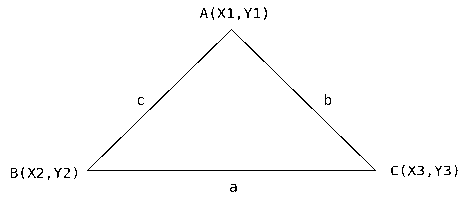
E.G. Side 'a' would have a length of:

From the length of each side a number (P) between 0 & 100 was calculated using the formula:
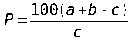
When a is the shortest side and c the longest.
If P was found to be less than 2 for any 3 sites then the sites were taken to be
in line. (Other values of P were also used.)
|


