"Young Scientists Of The Year 1977" Heat
"Young Scientists Of The Year 1977" Final
CertificatesCertificates were awarded for both the original "Win A Computer" competition and "Young Scientists Of The Year":
BroadcastsThe programmes were broadcast on BBC1 in March 1977: The Heat was shown on Sunday March 6th 1977. The Final was shown on Sunday March 27th 1977.
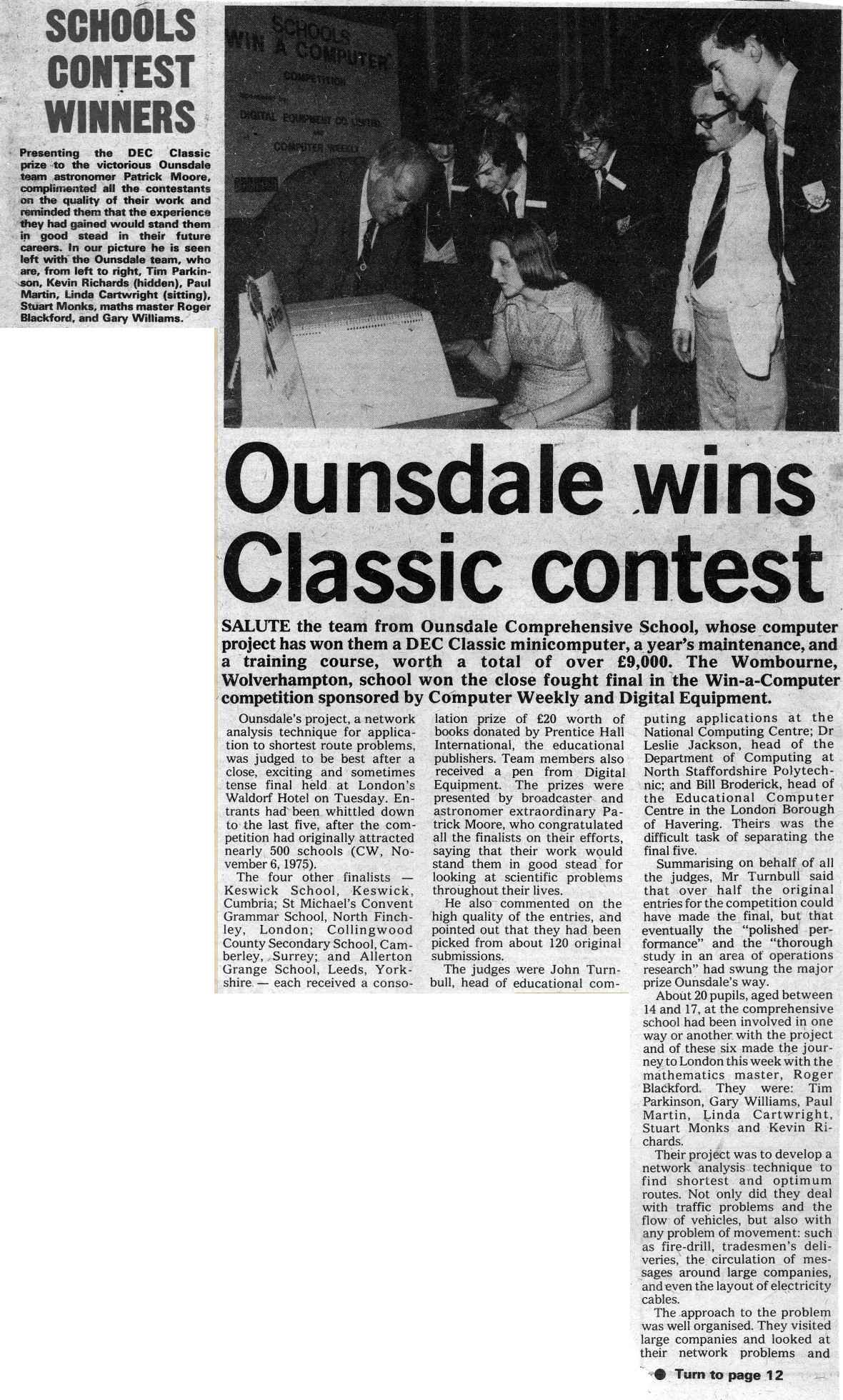
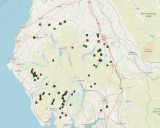
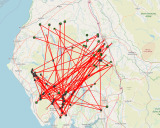
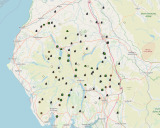
Later EventsSome time after the original competition, where we didn't win the Digital Equipment Corporation computer, Keswick School was contacted by Computer Weekly. The paper had received an enquiry from a "Bakery Firm", somewhere in the South of England, asking for ideas as to what to do with an old computer that they were replacing. Computer Weekly suggested that they could donate it to Keswick School, as we had done so well in the competition! The result was that a large lorry delivered an ICT 1902 computer (ICT being a predecessor of ICL), plus peripherals, to Keswick School. This machine was probably less powerful than the prize computer - but was about an order of magnitude larger in physical size. It also required a three-phase mains power supply, which took a long time to have installed. Eventually the machine was powered up, with much clunking of mechanically damped delay-relays and flashing lights. That was as far as it ever went, though. No programs were ever loaded or run and we never actually knew whether it was really in full working condition at all. Shortly after all of this, the school purchased its first Commodore PET, which proved to be a much more appropriate computer for the pupils (particularly me!) to learn with. The ICT equipment did not completely go to waste, however. For my "A"-level Computer Studies practical project, I built an interface to allow the PET to use one of the old ICT electro-mechanical teletype units as a printer. Finally, at about the time I left Keswick School in the early 1980s, it was decided that the redundant ICT 1902 should be scrapped. I managed to get permission to extract some rather useful and/or interesting components from it, before it was hauled away to the scrapyard. The high-current multi-output power supplies from the (huge) paper-tape punch and reader units were invaluable to me in my on-going electronics construction hobby. The magnetic Core Store from the CPU (which was 16 K-words of 25 bits, including one parity bit) amazed and intrigued various of my work colleagues for many years, before I donated it in 2010 to The National Museum of Computing at Bletchley Park. Ley-Lines Re-VisitedUPDATE: March 2019 A rather glaring typographical error has come to light, which placed the stone circle at Shap on St Sunday Crag! The grid reference in the original typed document had a "3" at the start of the Eastings, which, with even the most trivial check, should clearly be a "5". The results below have been refreshed based on the corrected value. The only change was a slight reduction in the number of alignments produced by three of the algorithms, plus a single extra alignment being detected by one other algorithm. A couple of minor errors in site names have also been corrected. Also, the graphical links to the data and results at the bottom of this page now display them on dynamic maps once again. It was during the work to do this that the above typos were noticed. UPDATE: August 2024 A minor bug was discovered relating to the conversion of the handwritten BASIC program into a more modern dialect. The "bwbasic" interpreter (version 2.20) was previously used, but this had the unexpected feature of always performing at least one iteration of a 'FOR' loop - even if the start value in the range of the loop was higher than the finish value. The original HP 9830A BASIC interpreter did not exhibit this behaviour. Post-processing of the output generated by 'bwbasic' attempted to catch occurrences of this situation, but it transpired that spurious alignments were still being counted. Changing to use the "yabasic" interpreter (version 2.90.3), which behaves as expected, highlighted the issue which has now been fixed. The results table below has been updated with the one value that needed to be correcting, which was a reduction from 235 to 234. It is also interesting to note that 'yabasic' is many times faster running the transliterated BASIC code than 'bwbasic' had been. While I was going through all my old material from the Castlerigg Project, I began to wonder what current technology might be able to add. It didn't take me long to write a Perl script to convert the list of ancient sites from the "Further Work on Ley-Lines" document into a KML file to produce a Map of all the real sites. You can load this into a Geographic Information System (GIS). If you then zoom in and look closely, you might notice that not every site is bang on top of what is shown on the aerial image. However, all the ones that I have checked do seem to be pretty close - certainly given that the grid references only have a precision of 100m. Various alignment detection algorithms have been used in the modern re-analysis. The data set for real sites was that containing the 100 entries from the "further work on the Ley-Lines" document. You will notice that the allowed error values (i.e. permitted deviation from an exact straight line), used when detecting alignments, are quite small. This is because allowing larger values results in ridiculously vast numbers of alignments for both the real and random data. Multiple control (random) data sets were generated and the various algorithms run against these. The results in the table below are for 100 sets of 100 (to match the number or real sites) random locations over the same basic area as the real data. The same 100 sets of sites were used for each algorithm. For the random sites, the minimum, maximum and average number of alignments are given. My understanding of statistics is not up to calculating (or fully appreciating the meaning of!) the chi-squared parameter for these, so that is not included here.
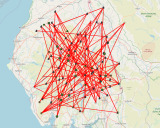
The above results agree with the original work, in that there do not appear to be significantly more alignments in the real data than in random data. There does, however, appear to be an extra factor that was not fully considered in the original analysis. The data for the real sites is actually quite "clumpy", in that there are areas where there are multiple sites in close proximity. This can lead to spurious calculated alignments when there are two sites very near to each other and a third site many miles away. This can increase the occurrence of apparent alignments where, by manual examination, it is clear that there is no real line at all. The different algorithms seem to have different sensitivities to this. It should be possible to compensate for the effect, by either making the alignment detection algorithm more rigorous or by generating random data-sets that are equally as "clumpy" as the real data. A quick play with the latter approach confirmed that "clumpy" random data results in higher numbers of alignments.
You should remember, however, that a set of random data over the same area (which produces a realistic looking map of random sites) will also result in a similar number of alignments between sites in the randomly generated data!
|
|
|||||||||||||||||||||||||||||||||||||||||||||||||||||||||||||||||||||||||||||||||||||||||||||||||||||||||||||||||||||||||||||||||||||||||||||||||||||||||||||||||||||||
 The Castlerigg Project









| The Personal Planet is maintained by Dave Wylie djwpptag David Wylie | Last significant update: Sunday 13th February 2022 David J. Wylie |